
B2B leaders know the goal: more predictable growth that’s easier to scale. The challenge is turning ambition into coordinated action across teams, systems and measurement.
That gap is the focus of Walker Sands’ new 2026 B2B Growth Maturity Assessment. Based on a survey of 200 senior leaders across sales, marketing and executive functions at B2B organizations generating more than $100 million in annual revenue, our latest report examines where growth maturity is breaking down and where organizations can gain ground.
For B2B enterprises pursuing faster, more consistent growth, the message from our research is clear: Growth strategy, systems and execution must operate as a unified go-to-market (GTM) engine.
In my work with B2B brands over the past 15 years, I’ve seen how often strong growth ambitions are slowed by disconnected teams, tools and measurement. The maturity of B2B organizations’ growth efforts has certainly improved — as evidenced by our report and previous research in this space — but significant alignment and execution gaps still remain.
When GTM strategy and systems work together, teams can align earlier and execute more consistently. The opportunity is less about asking B2B leaders to increase their outputs and more about removing common barriers that make business growth harder to predict and scale.
Our research surfaced several lessons that show where growth maturity gaps persist and what enterprise teams can do to close them. Let’s take a closer look at three of them.
Key Takeaways
- B2B’s next growth performance wave will take cross-functional orchestration. Predictable business growth requires brand, demand, sales and revenue operate against shared outcomes across the full buyer journey.
- Strategy only works when the operating model supports it. Enterprise leaders may understand what mature B2B growth looks like, but fragmented systems, decision-making and execution can keep strategy from translating into results.
- Measurement must connect marketing activity to business impact. Mature organizations need more than activity reporting — they deserve trusted measurement that shows revenue influence and helps leaders make better business decisions.
Lesson 01: Predictable Business Growth Requires Brand, Demand and Revenue to Work as One
Enterprise B2B organizations often talk about growth as a linear progression: build awareness, generate demand, create pipeline, close revenue.
In practice, buyers don’t move so neatly. They discover brands across channels, encounter influence from multiple sources and leave behind signals that don’t live cleanly within one team or system. As a result, growth opportunities suffer as marketing, sales and executive leadership optimize for different workflows and definitions of success.
What stands out in our research is how clearly growth maturity goes beyond channel-level performance. It depends on whether the organization can make coordinated decisions across functions and the entire revenue lifecycle.
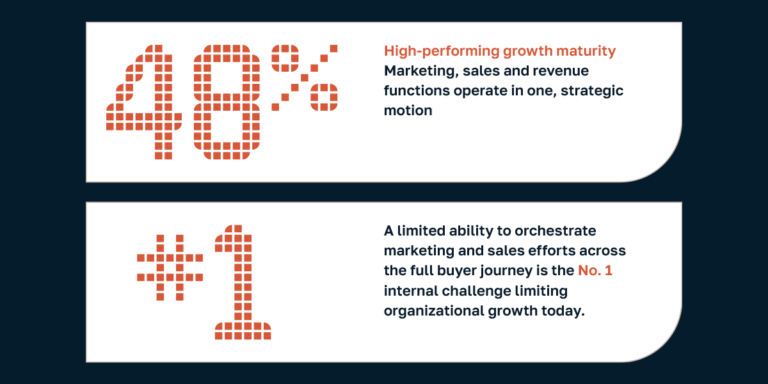
Right now, B2B leaders are falling short on this goal. Less than half (48%) of B2B leaders rate their organization’s level of growth maturity as high performing — and a limited ability to orchestrate marketing and sales efforts across the full buyer journey was the most commonly cited internal challenge limiting organizational growth today.
Enterprises must align teams around shared business outcomes, define decision ownership and establish an operating model that connects early marketing activity to downstream revenue impact. Without that alignment, the business may still grow, but with more friction, less confidence and far less predictability.
Lesson 02: GTM Strategy Can’t Outperform the Operating Systems Behind It
One of the clearest tensions in our research is the gap between strategic intent and operational readiness.
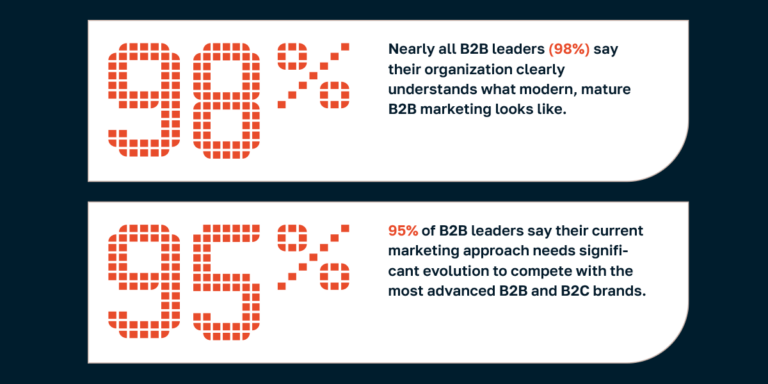
Many B2B enterprise leaders can describe mature growth. In fact, nearly all B2B leaders (98%) say their organization clearly understands what modern, mature B2B marketing looks like. They know the organization needs tighter alignment, stronger collaboration and more rigorous measurement. The hard part is turning that understanding and strategic vision into an operating model that holds up in day-to-day enterprise execution.
The scale of that challenge comes through in another report finding: 95% of B2B leaders say their current marketing approach needs significant evolution to compete with the most advanced B2B and B2C brands.
Taken together, these trends show why strategy and systems are inseparable. GTM strategy determines where the business is trying to go. GTM systems determine whether it can get there consistently. If the strategy is strong but the systems are fragmented, execution is uneven. If the systems are sophisticated but the strategy is unclear, teams may generate ample activity without shared direction or impact.
In either case, growth underperforms because the link between strategy and systems is insufficient.
Improving marketing strategy alone isn’t enough, even though it tends to be where B2B brands spend more of their energy. Organizations need an equally sophisticated GTM operating model that turns strategy into something the business can execute, measure and continuously improve.
That evolution matters even more in enterprise environments, where complexity compounds quickly. More channels, stakeholders, tools and buying signals don’t automatically create maturity — they often expose where maturity is missing.
Lesson 03: Measurement Should Build Trust in Business Decisions, Not Just Report on Activity
Enterprise marketing teams have spent years being asked to prove impact. That pressure isn’t new. What’s changing is the level of proof leaders require and how directly they expect marketing activity to connect to measurable business outcomes.
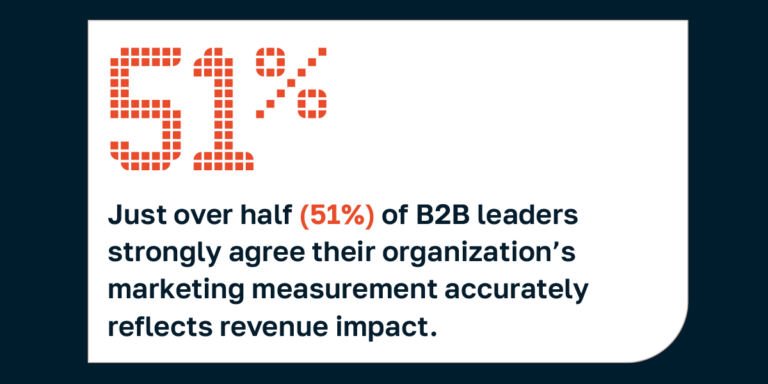
Our report exposes an important gap: Just over half (51%) of B2B leaders strongly agree their organization’s marketing measurement accurately reflects revenue impact. Leaders increasingly prioritize business outcomes, but many organizations still lack the measurement framework to define, capture and interpret those outcomes consistently.
That distinction matters. Reporting activity isn’t the same as informing decisions. Dashboards can be full and still fail to build confidence. Attribution can exist and still misrepresent how buyers move. Data can be abundant and still go unused because leaders don’t trust it.
When measurement breaks down, marketing can appear disconnected from revenue even when it influences pipeline.
And when leaders don’t trust the measurement model, they’re more likely to make shorter-term decisions, shift investment too quickly and undermine the systems that can improve performance over time. Nearly nine out of 10 (89%) B2B leaders across marketing, sales and executive functions agree that misalignment between marketing, sales and business leadership makes it harder to balance short-term revenue demands with long-term growth priorities.
Mature measurement creates a common language across marketing, sales and executive leadership. For enterprise B2B brands, that translates into a clearer view of what’s working, what isn’t and where to invest next.
Say Goodbye to Growth Maturity Gaps
Our research confirms B2B leaders are ready to drive growth. The challenge ahead is closing the distance between what that growth should look like and what the organization can consistently deliver.
Addressing today’s growth maturity gaps helps leaders see where strategy breaks down, where systems create friction and where measurement fails to provide the insights teams need. More importantly, it shows what’s possible when GTM strategy and systems are designed to work together every day.
If your team is ready to build a GTM engine that supports more predictable business growth, The 2026 B2B Growth Maturity Assessment offers a practical starting point. Use it to pressure-test your current growth model, identify the biggest barriers and prioritize the changes that can inspire more connected, repeatable growth.
Close the gaps. Align the engine. Accelerate growth.

